


AstraZeneca: Efzimfotase alfa showed numerical improvement in 6-Minute Walk Test achieving mean difference of 17.05 metres vs placebo in treatment-naïve adolescents, adults with HPP at week 25 in HICKORY Ph3 trial
Efzimfotase alfa showed improvement across primary and all key secondary endpoints including in fatigue and pain vs placebo at week 25 with continued improvement up to week 49. Efzimfotase alfa recently granted Priority Review in the US.
Results from the HICKORY Phase III trial showed that efzimfotase alfa (ALXN1850), an investigational enzyme replacement therapy, did not achieve statistical significance but demonstrated a numerical improvement in the primary endpoint of Six-Minute Walk Test (6MWT) in adolescents and adults (≥12 years of age) with hypophosphatasia (HPP) who had not been previously treated with Strensiq (asfotase alfa) at week 25, compared to placebo.1
In the overall population, at week 25, efzimfotase alfa achieved a least squares (LS) mean difference of 17.05 metres (p=0.1675) change from baseline in the primary endpoint of 6MWT, compared to placebo. The lack of statistical significance was largely due to better-than-expected results observed in the adult-onset HPP placebo group.1
In a post hoc analysis, at week 25, 45.2% of patients treated with efzimfotase alfa achieved the minimum clinically important difference (MCID) from baseline in 6MWT (defined as 43 metres in adolescents and 31.1 metres in adults), compared to 30.0% in the placebo group (odds ratio = 2.50 [95% CI: 1.06, 5.91; nominal p=0.0363]), indicating a 2.5-fold higher odds of achieving a clinically meaningful 6MWT response.1
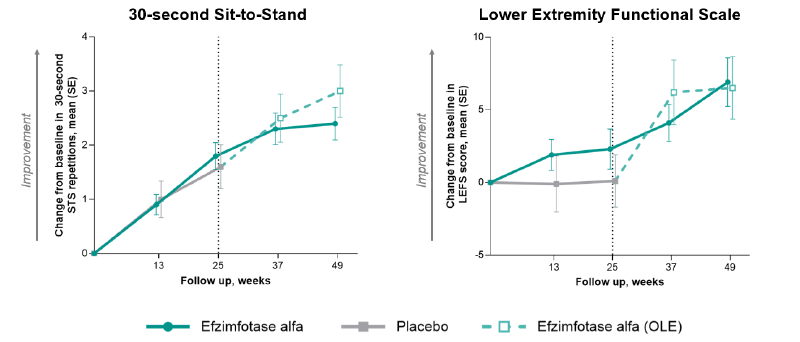
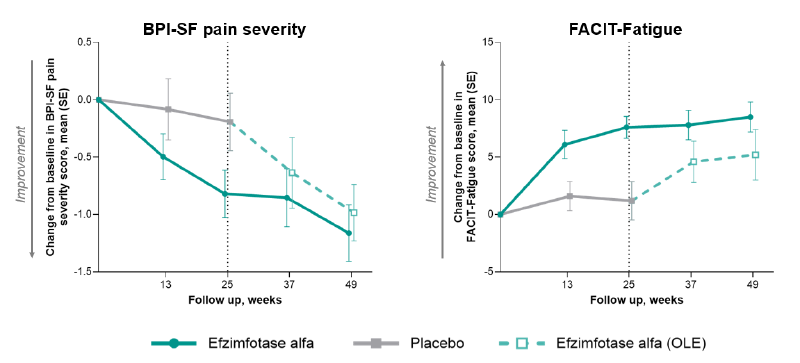
In the overall population, at week 25, efzimfotase alfa demonstrated nominally significant improvement in the key secondary endpoint of FACIT-Fatigue, achieving an LS mean difference of 5.74 (nominal p=0.0016) vs placebo. Other key secondary endpoints numerically favoured efzimfotase alfa, including 30-second Sit-to-Stand (30s-STS), Lower Extremity Functional Scale (LEFS) and BPI-SF Pain Severity.1
In the open-label extension, at week 49, patients treated with efzimfotase alfa showed continued improvement across the primary and key secondary endpoints, including 6MWT, 30s-STS, LEFS, BPI-SF Pain Severity and FACIT-Fatigue, and patients switching from placebo to efzimfotase alfa following the randomised evaluation period at week 25 demonstrated similar improvement in these key measures of mobility, physical function, pain and fatigue.1
In a combination of prespecified subgroups of adolescents and adults with paediatric-onset HPP, efzimfotase alfa demonstrated nominally significant and clinically meaningful benefits in the primary endpoint of 6MWT, achieving an LS mean difference of 35.6 metres (nominal p=0.0386) vs placebo at week 25, as well as the key secondary endpoints of 30s-STS (LS mean difference vs placebo: 1.3; nominal p=0.0384) and BPI-SF Pain Severity (LS mean difference vs placebo: -1.0; nominal p=0.0260). In a prespecified subgroup of adults with adult-onset HPP, efzimfotase alfa demonstrated clinically meaningful improvement in the key secondary endpoint of LEFS (LS mean difference vs placebo: 3.5; nominal p=0.2376) and nominally significant and clinically meaningful improvement in FACIT-Fatigue (LS mean difference vs placebo: 7.41; nominal p=0.0021).1
Kathryn Dahir, MD, Director of the Programme for Metabolic Bone Disorders at Vanderbilt Health and Associate Director for Clinical Research Translation, Professor in the Department of Internal Medicine, Division of Endocrinology, Diabetes and Metabolism and lead investigator in the HICKORY trial, said: "For adolescents and adults, the chronic and progressive disease burden of HPP can have far-reaching impact on physical function and emotional wellbeing, potentially impairing people's ability to live independently, form connections and sustain employment. These results from the HICKORY Phase III trial signal benefits across multiple clinically relevant endpoints and represent an important step toward potentially bringing this advanced enzyme replacement therapy to a broad range of people who may benefit."
Gianluca Pirozzi, Senior Vice President, Head of Development, Regulatory and Safety, Alexion, AstraZeneca Rare Disease, said: "The HICKORY Phase III trial builds on the positive results from the MULBERRY and CHESTNUT trials and demonstrates the potential of efzimfotase alfa to address the diverse and complex clinical manifestations of HPP across a broad population of patients. With the recently granted Priority Review in the US, we look forward to bringing this potential new therapy with favourable tolerability and dosing convenience to the HPP community, including those with limited treatment options."
Summary of results at week 25: HICKORY
| Endpoint | Efzimfotase alfa (n=84) vs placebo (n=40) LS mean difference (SE) |
| Overall population | |
| Primary endpoint: 6MWT | 17.05 (12.223) p=0.1675 |
| Key secondary endpoints | |
| 30s-STS | 0.42 (0.455) Nominal p=0.3581 |
| LEFS | 3.56 (2.173) Nominal p=0.1055 |
| BPI-SF Pain Severity | -0.60 (0.300) Nominal p=0.0508 |
| FACIT-Fatigue | 5.74 (1.733) Nominal p=0.0016 |
| Paediatric-onset subgroup (n=60) | |
| Primary endpoint: 6MWT | 35.6 (16.87) Nominal p=0.0386 |
| Key secondary endpoints | |
| 30s-STS | 1.3 (0.61) Nominal p=0.0384 |
| LEFS | 3.7 (3.31) Nominal p=0.2645 |
| BPI-SF Pain Severity | -1.0 (0.45) Nominal p=0.0260 |
| FACIT-Fatigue | 3.5 (2.64) Nominal p=0.1876 |
| Adult-onset subgroup (n=64) | |
| Primary endpoint: 6MWT | -2.70 (17.32) Nominal p=0.8764 |
| Key secondary endpoints | |
| 30s-STS | -0.43 (0.62) Nominal p=0.4927 |
| LEFS | 3.5 (2.91) Nominal p=0.2376 |
| BPI-SF Pain Severity | -0.26 (0.40) Nominal p=0.5222 |
| FACIT-Fatigue | 7.41 (2.29) Nominal p=0.0021 |
LS, least squares; SE, standard error; 6MWT, Six-Minute Walk Test; 30s-STS, 30-second Sit-to-Stand; LEFS, Lower Extremity Functional Scale; BPI-SF Pain Severity, Brief Pain Inventory-Short Form Pain Severity; FACIT-Fatigue, Functional Assessment of Chronic Illness Therapy-Fatigue
Primary endpoint 6MWT at week 25 and week 49
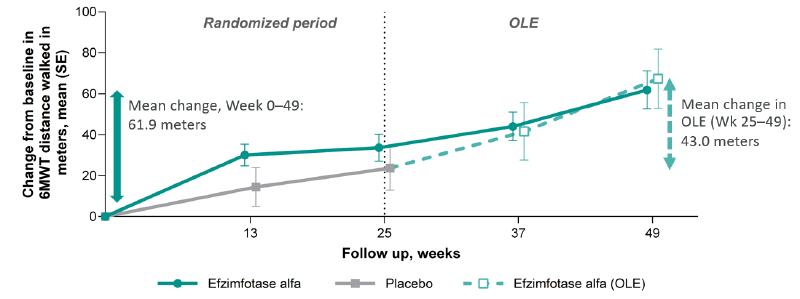
Patients continuing efzimfotase alfa in the OLE had clinically meaningful improvements in 6MWT distance walked (≥43 metres in adolescents, ≥31.1 metres in adults) at week 37 (mean [SD] change from week 1: 44.1 [60.3] metres) and at week 49 (mean [SD] change from week 1: 61.9 [78.4] metres). Patients switching to efzimfotase alfa in the OLE had clinically meaningful improvements in 6MWT distance walked at week 49 (mean [SD] change from week 25: 43.0 [71.0] metres).
Key secondary endpoints at week 25 and week 49
Efzimfotase alfa demonstrated a favourable safety profile and was generally well-tolerated across all three Phase III clinical trials. In a pooled analysis of MULBERRY and HICKORY trials, the annualised Injection Site Reaction (ISR) rate was five times lower with efzimfotase alfa compared to Strensiq in its registrational trials during the first 24 weeks of treatment. In that analysis, including data from the open-label extension, patients treated with efzimfotase alfa achieved a median of 98.8% ISR-free days while on treatment.1
Results from the HICKORY Phase III trial were presented today in an oral session at the 2026 American Society for Bone and Mineral Research (ASBMR) Annual Meeting in Boston, Massachusetts. Results from the MULBERRY and CHESTNUT trials were recently presented at the 12th International Conference on Children's Bone Health (ICCBH).
Notes
Hypophosphatasia
Hypophosphatasia (HPP) is a rare, chronic, inherited metabolic disease caused by deficient activity of the enzyme alkaline phosphatase (ALP), which is important for building healthy bones and supporting proper muscle function.2 HPP is characterised by defective mineralisation (the process that hardens and strengthens bones and teeth), impaired calcium and phosphate regulation and functional impairments, such as muscle weakness, neurologic symptoms, generalised fatigue and pain that can be debilitating.2,3 HPP can be progressive, and clinical manifestations may occur at any age and evolve over time. The addressable HPP patient population is estimated at 13,800 across the US, Germany, France, UK, Italy, Spain, Japan and China.4 HPP affects people of all ages, with approximately 80% of people living with HPP being adults based on a US prevalence study.2,3,5
MULBERRY
MULBERRY is a global Phase III randomised, double-blind, placebo-controlled, multicentre trial evaluating the efficacy and safety of efzimfotase alfa (ALXN1850) in paediatric patients (2 to <12 years of age) with hypophosphatasia (HPP) who have not been previously treated with Strensiq (asfotase alfa). The trial enrolled 29 patients from 14 countries across North America, South America, Europe and Asia.6
Patients were required to have an HPP diagnosis and the presence of HPP-related rickets on skeletal X-rays and low serum alkaline phosphatase (ALP) activity. Eligible patients also needed to demonstrate either a variant in ALPL, the gene encoding ALP, or elevated levels of plasma pyridoxal 5'-phosphate (PLP), a biomarker of HPP.6
Patients were randomised 2:1 to receive efzimfotase alfa at one of three doses based on predefined weight ranges or placebo, once every two weeks via subcutaneous injection for 24 weeks. The primary endpoint Radiographic Global Impression of Change (RGI-C) Score was assessed at the end of the randomised evaluation period (Day 169), along with multiple secondary endpoints measuring skeletal health and physical function, including change from baseline in the Rickets Severity Score (RSS), Six-Minute Walk Test (6MWT), Bruininks-Oseretsky Test of Motor Proficiency Score (BOT-2) and Peabody Developmental Motor Scales Score (PDMS-3).6
Patients who completed the randomised evaluation period were eligible to continue into an open-label extension period evaluating the safety and efficacy of efzimfotase alfa, which is ongoing.6
CHESTNUT
CHESTNUT is a global Phase III randomised, open-label, active-controlled, multicentre trial evaluating the safety and tolerability of efzimfotase alfa in paediatric patients (2 to <12 years of age) with hypophosphatasia (HPP) who have been treated with 6 mg/kg per week of Strensiq (asfotase alfa) for at least 6 months prior to study initiation. The trial enrolled 43 patients from seven countries globally.7
Patients were required to have an HPP diagnosis and have been treated with Strensiq for at least 6 months before the start of the trial with open growth plates confirmed by X-ray.7
Patients were randomised 1:1 to receive efzimfotase alfa at one of three doses based on predefined weight ranges once every two weeks or 6 mg/kg/week of Strensiq via 3x or 6x subcutaneous injections per week for 24 weeks. The primary endpoint is the incidence of treatment-emergent adverse events (TEAEs) at the end of the randomised evaluation period. Key secondary endpoints include change from baseline in the Rickets Severity Score (RSS) and Radiographic Global Impression of Change (RGI-C).7
Patients who completed the randomised evaluation period were eligible to continue into an open-label extension period evaluating the safety and efficacy of efzimfotase alfa, which is ongoing.7
HICKORY
HICKORY is a global Phase III randomised, double-blind, placebo-controlled, multicentre trial evaluating the efficacy and safety of efzimfotase alfa (ALXN1850) in adolescents (12 to <18 years of age) and adults with hypophosphatasia (HPP) who have not been previously treated with Strensiq (asfotase alfa). The trial enrolled 124 patients from 17 countries across North America, South America, Europe, Asia and Australia.8
Patients were required to have an HPP diagnosis and either a variant in ALPL, the gene encoding alkaline phosphatase (ALP), or elevated levels of plasma pyridoxal 5'-phosphate (PLP), a biomarker of HPP. Eligible patients needed to demonstrate low ALP levels and two separate Six-Minute Walk Tests (6MWTs) below 85% of the predicted distance adjusted for age, sex, weight and height, without a probable cause other than HPP.8
Patients were randomised 2:1 to receive efzimfotase alfa at one of three doses based on predefined weight ranges or placebo, once every two weeks via subcutaneous injection for 24 weeks. The primary endpoint of change from baseline in 6MWT was assessed at the end of the randomised evaluation period (Day 169), along with multiple key secondary endpoints measuring physical function, pain, fatigue, quality of life and safety, including change from baseline in 30-second Sit to Stand (STS) Test Score, Lower Extremity Functional Scale (LEFS) Score, Brief Pain Inventory Short Form (BPI-SF) Score and Functional Assessment of Chronic Illness Therapy - Fatigue (FACIT-Fatigue) Score.8
Patients who completed the randomised evaluation period were eligible to continue into an open-label extension period evaluating the safety and efficacy of efzimfotase alfa, which is ongoing.8
Efzimfotase Alfa (ALXN1850)
Efzimfotase alfa (ALXN1850) is an investigational enzyme replacement therapy (ERT) designed to demonstrate efficacy and safety in a broad range of patients with hypophosphatasia (HPP) aged ≥ 2 years, including patients without overt bone manifestations. Efzimfotase alfa is being developed as a subcutaneous treatment administered every two weeks to replace the deficient alkaline phosphatase (ALP) enzyme activity that is the underlying cause of HPP. Efzimfotase alfa has been granted Priority Review by the US FDA for the treatment of patients with HPP aged 2 years and older.
Strensiq (asfotase alfa)
Strensiq is an enzyme replacement therapy designed to address the underlying cause of hypophosphatasia (HPP) - deficient alkaline phosphatase (ALP). By replacing deficient ALP, treatment with Strensiq aims to improve the elevated enzyme substrate levels and improve the body's ability to mineralise bone, thereby preventing serious skeletal and systemic patient morbidity and premature death.
Strensiq is approved in the US, EU, Japan and other countries for the treatment of certain patients with HPP. Strensiq has been granted orphan drug designation by the US Food and Drug Administration (FDA), the European Medicines Agency (EMA) and the Japanese Ministry of Health, Labour and Welfare (MHLW).
Alexion
Alexion, AstraZeneca Rare Disease, is focused on serving patients and families affected by rare diseases and devastating conditions through the discovery, development and delivery of life-changing medicines. A pioneering leader in rare disease for more than three decades, Alexion was the first to translate the complex biology of the complement system into transformative medicines, and today it continues to build a diversified pipeline across disease areas with significant unmet need, using an array of innovative modalities. As part of AstraZeneca, Alexion is continually expanding its global geographic footprint to serve more rare disease patients around the world. It is headquartered in Boston, US.
AstraZeneca
AstraZeneca (LSE/STO/NYSE: AZN) is a global, science-led biopharmaceutical company that focuses on the discovery, development, and commercialisation of prescription medicines in Oncology, Rare Disease, and BioPharmaceuticals, including Cardiovascular, Renal & Metabolism, and Respiratory & Immunology. Based in Cambridge, UK, AstraZeneca's innovative medicines are sold in more than 125 countries and used by millions of patients worldwide. Please visit astrazeneca.com and follow the Company on Social Media @AstraZeneca.
Contacts
For details on how to contact the Investor Relations Team, please click here. For Media contacts, click here.
References
- Efficacy and Safety of Alkaline Phosphatase (ALP) Enzyme Replacement Therapy (ERT) Efzimfotase Alfa in Adolescents and Adults with Hypophosphatasia (HPP): Results of HICKORY as Part of a Three-Trial Phase 3 Clinical Program. Presented at the American Society for Bone and Mineral Research (ASBMR) Annual Meeting; 2026 October 11; Boston, Massachusetts.
- Rockman-Greenberg C. Hypophosphatasia. Pediatr Endocrinol Rev. 2013;10(2):380-388.
- Dahir KM, et al. Clinical profiles of treated and untreated adults with hypophosphatasia in the Global HPP Registry. Orphanet J Rare Dis. 2022;17(1):277.
- AstraZeneca Data on File - Epidemiology estimates are composed of a triangulation of different data sources including Data Monitor, Decision Resources Group, Kantar Health, and internal input. Available here. Accessed October 2026.
- Fang S, et al. Diagnosed prevalence of hypophosphatasia: a retrospective analysis of electronic health records in the United States. Poster presented at ASBMR 2025 Annual Meeting; September 5-8, 2025; Seattle, WA.
- ClinicalTrials.gov. Phase 3 study of ALXN1850 in treatment-naïve pediatric participants with HPP (MULBERRY). NCT Identifier: NCT06079359. Available here. Accessed October 2026.
- ClinicalTrials.gov. Phase 3 study of ALXN1850 in pediatric participants with HPP previously treated with asfotase alfa (CHESTNUT). NCT Identifier: NCT06079372. Available here. Accessed October 2026.
- ClinicalTrials.gov. Phase 3 study of ALXN1850 versus placebo in adolescent and adult participants with HPP who have not previously been treated with asfotase alfa (HICKORY). NCT Identifier: NCT06079281. Available here. Accessed October 2026.